Friday, June 23, 2006

Colorado

The trip to Colorado was incredible. Being a sworn and proud flatlander, it's always edifying to head into the mountains. We spent two days in Frisco/Breckenridge where I got some good training hikes into the Eagle's Peak Wilderness area above Frisco, CO, then on to Ouray, CO, where I was able to hit many of the town trails such as Portland Mine, Silvershield, and the Cascade system, along with the Red Mountain area between Ouray and Silverton, maxing out at 13,000 feet. Mostly hiking, a little downhill running, although I was surprised the altitude really didn't affect me much until over 12,000 ft. On to Colorado Springs for Pike's Peak, Garden of the Gods, etc. No 14ers this time, other than driving to the top of Pike's. Not enough time to get in to Sneffels or Sunlight. Next time for sure. Oh, and plenty of Fat Tire, Avalanche, and Black Butte to grease the gears.

Still, the San Juan Mountains around Ouray and Silverton have to be among the most stunning mountains on the planet. Hardrock is a fantasy goal for sometime before I die. Or maybe as I'm dying? Whatever it takes. A few obligatory pics:


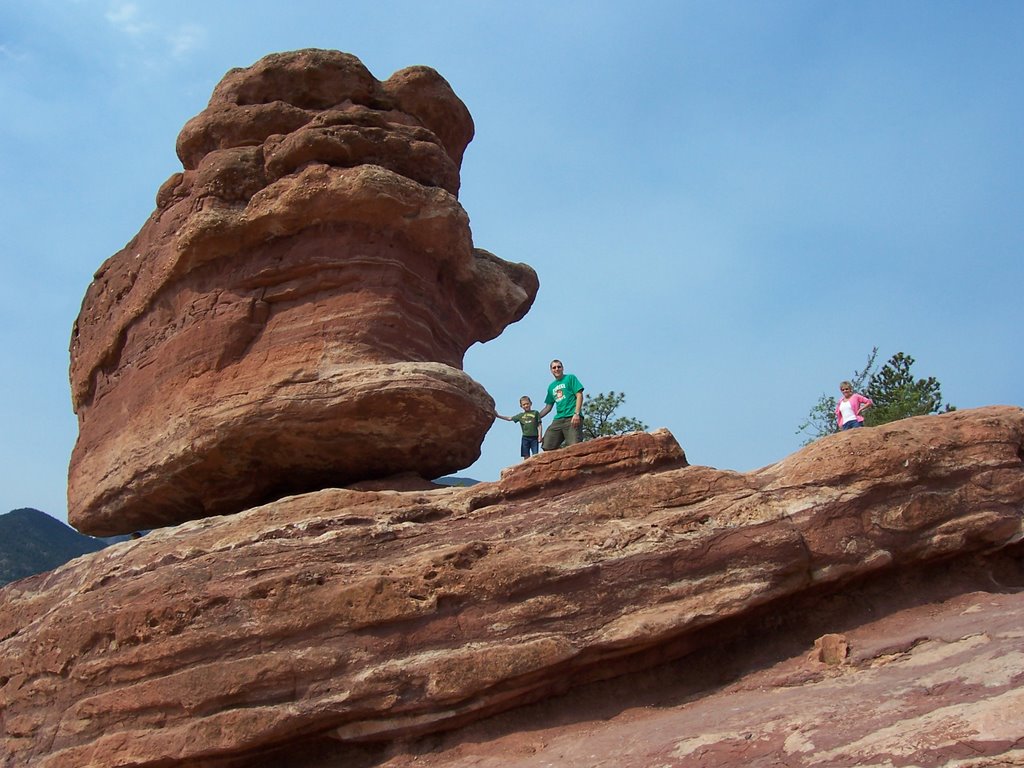
Famous balancing rock at Garden of the Gods
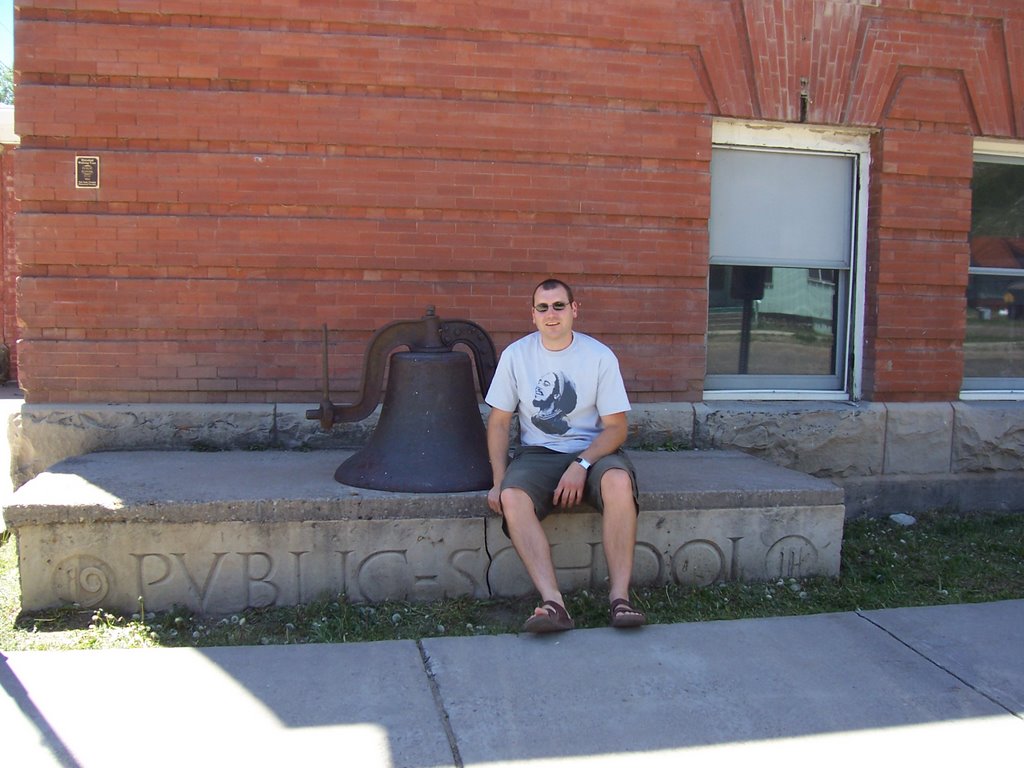


Public school in Silverton, CO., start of Hardrock.


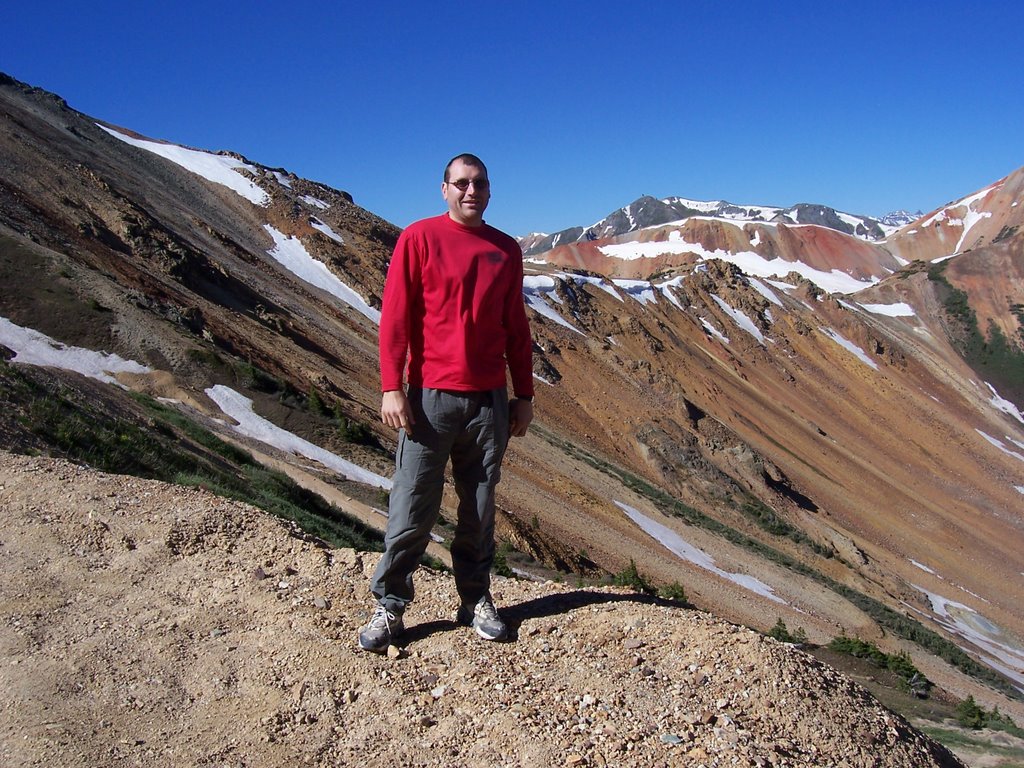
On the pass up between Red Mtn I and II.


Black Canyon of the Gunnison-- Montrose, CO. Not as wide as the Grand Canyon, but just as breathtaking.


Red Mtn area looking, I think, toward Wetterhorn Peak.


Taken from rutted Jeep road between Ouray and Silverton, near California Pass.

Tuesday, June 13, 2006

Off to the Mountains

Been getting in some good miles for Howl at the Moon. Did a good half marathon tempo run on the flat limestone Rock Island Trail two weeks and then a good 3 hour run at Farmdale on Sunday morning. I'm a bit nervous about doing long distance on a flat surface, as I tend to get hip soreness without hills, but hopefully all will go well.

Also, met with Dave and Marvin to plan Dave's run across Illinois. He decided to go from west to east, starting in the Quad Cities and utilizing the Hennepin, I & M Canal, and Old Plank trails as much as possible, finishing on the Indiana border in 4 days. I hope to get to crew at least part of the time.

Off to Colorado for a week of the mountains. Back in 8 days.

Monday, June 05, 2006

Farmdale Trail Runs

My friend, Dave Tapp, is spearheading a new event in central Illinois this fall--the Farmdale Trail Runs. There will be an 8 mile event and a 32.5 mile ultra distance on some great trail. The race will be on Sat., October 14 at the Farmdale Resevoir in Sunnyland (East Peoria), IL. The route highlights the best of this area: lots of wooded single track through hardwood and pine forest, water crossings, a few hills, some open meadow areas, wildlife (not just the runners).

We spent Memorial day morning measuring the course with local orienteering expert, Marvin Doyle.

Dave has put some info, pics and course descriptions on his website. You can contact him through there for more: http://happytrailrunner.blogspot.com/

Tuesday, May 30, 2006

A Run in the Woods, Part II

Continued from Part I below...


When the first European settlers arrived in the early 19th century with the intentions of staying, they found a vast ocean of grasses: big and little bluestem, switchgrass, wildflowers such as compass plant, rattlesnake master, purple coneflower, pestemon. In groves and alluvial areas they found a mature forest with several varieties of oak, giant cottonwoods and sycamores, some ash and birch, hornbeam, walnut, and various types of maples. They made detailed land survey records that give us a snapshot of what the land looked like right at the genesis of white settlement in the 1820's and 30's, a period that brought the axe and the plow, the removal of the grasses for cultivation and logging of the forests for building material.

So where does this leave me today on my run in the woods today? Well, I'm certainly looking what is almost entirely second or third growth trees, no prairie (save one native, but tiny hilly prairie remnant in Forest Park), lots of invasive species; in short, a very modified form of any of the natural stages of ecological evolution and the environment as it existed upon contact.

If you want to see the only example of old growth forest left in centrail IL., then take a trip to Funk's Grove, south of Bloomington. The term "old growth" simply isn't in our vernacular. Sure, some large oaks still exist in isolated hollows around the Illinois River, but even its ancient bluffs have been significantly altered. Whereas man made fires and culling used to keep the understory cleared out, we now have an almost entirely closed canopy and a densely forbed forest floor. Newer growth deciduous forest is still there, but the shade tolerant maples, with no burns to kill off their saplings, are outcompeting other species, and in 50-100 years they'll dominate if not thinned and managed and a bed created to promote the growth of the more needy native oaks. Non-native species--too numerous to list--are everywhere.

I try and make no value judgments. The accusing stare of our "roadsides for habitat" are all we need to remind of what is lost. But land, by law of nature, is never static; please take care to remember that we live in the holocene, the current interglacial. Things will change and gain balance as they warrant. We will be outlasted by "nature," for she is nothing if not patient, and blissfully uncaring of our petty temporal restraints.

In the short term it is up to us to decide how our runs in the woods will look and feel. Is a tree a tree? Do enough of us even care or perhaps even notice the difference between a two or three hundred year old oak--a silver maple sappling--a thorn laced honey locust? Big bluestem or Kentucky bluegrass? Perhaps not. But the forest doesn't need us in order to go on. Mark Twain once wrote:

"When I was a boy, I looked into the river and saw my reflection. And I said, "Who's that?" My mother said, 'Samuel Langhorne Clemens.' In 1882 I returned to Hannibal, a celebrated writer and lecturer and steamboat pilot. And I looked into the river again. And I saw the reflection of an old man. And now, I look into the river and I see no reflection at all. We all come and we all go, but not the river..."

And yet I still try and frame my proper place in the world, contemplatitve of all that has been, is, and will be shaped long after my body is again part of the cycle. All on a run in the woods.

Wednesday, May 24, 2006

A Run in the Woods, Part I

In the 1980's, entomologist E.O. Wilson introduced a concept known as "biophilia," a hypothesis that suggests that human beings have an instinctive bond with other living systems. The startling idea that our love of the natural world is literally melded into our hardwiring.

An aspect of my personal biophilic tenedencies (that only sounds bad) involves land. I simply love land--its topography, flora, history, human provenance, character. My desire to more deeply explore these elements led to a specialty while studying History in grad school of Environmental History and Historical Geography, two closely related methodologies, the former using traditional historical research while borrowing from diverse scientific fields in a quest to explore how humans and "nature" have interacted, while the latter being the specific study of how a place changes over time.

All ecosystems have a story, but my primary interest lies with the Grand Prairie Section of my home in Illinois, to which I try and apply my historical training to better understand. On my many runs through the woods, the main question often framed in my mind is: "Just what am I looking at and experiencing?" Further, how have these landscapes come about and where do we go from this point? I hear from environmentallly minded folks all the time suggesting that we in the Midwest destroyed an entire prairie ecosystem in the matter of a few decades, and are in the process of desertifying what currently exists. In a way, yes, it is true, the tallgrass prairie/oak dominated lowlands are gone, almost entirely cultivated and logged since the mid-1800's (I did an entire thesis on this, but the details will be spared for now) but the fact is that all ecosystems are in a perpetual state of change.

We tend to romanticize "The Prairie" as being the paragon of pre-settlement ecological purity, the unspoiled wilderness defiled by pioneer hands. This simply isn't the case. I'm willing to set aside practices by native peoples such as burning, canal digging, damming of waterways, hunting and fishing of numerous animal species, all things that date back 100's of years before large scale settlement, and focus more on the effect of natural cycles on this particular environment.

In Illinois, glaciation has been the main sculptor of our topography during the 1.8 million years of the Pleistocene, the Illinoisian and Wisconsinian periods, from 180,000 to 17,000 years ago, being largely responsible for our current land forms.

The ice sheets reached their southern terminus near modern day Shelbyville, IL about 24,000 years ago. From that point northward retreating ice had the affect of a box scraper, in simplistic terms, levelling the uplands and leaving bogs and rudimentary waterways that drained glacial meltoff, these being constantly carved and then re-carved.

If I were to have stood in central Illinois in say, 15,000 BC or so, I wouldn't observe even the embryonic stage of the tallgrass prairie. Glacial and interglacial moisture and climatic conditions assured a completely dynamic patchwork of forests and tundra.

When I reach back into my being to the post-Illinoisan period, I can feel the cool, crisp air and smell the freshness of the developing spruce and pine forest, a scene similar to what exists today in southern Canada.

During the interglacial, as the climate warmed and moistened, a deciduous forest consisting primarily of oak, elm and hickory took hold. The pre-Wisconsin period ushered back cooler conditions and pollen samples dated from 30,000 years ago tell us that the coming ice razed a mature spruce forest, leaving a chain of meltwater lakes and swamps, then a tundra of sedge interlaced with the spruce remnants.

Analysis indicates that the resultant drying and cooling allowed an ash dominted forest makeup until around 10,000 BC, at which time dryer air brought back an oak/hickory/elm makeup that was able to dominate until 4,000-1,500 BC, when grasses gained a foothold in the uplands, leaving groves of oak forests as large islands and continued predominance of forest in the low areas where fire could not entirely penetrate--finally the "prairie" mosaic of our collective mythological imaginations--the land that the Illinois tribe and later bands of both Potawatomi and Kickapoo lived, hunted, celebrated and died on--the land my grandparents tilled, where I, as a postmodern man, seek my running refuge on.

...to be continued